

FREE GUIDE | ASSET PROTECTION
Asset Protection Fundamentals: are your assets protected properly?
The short version of our guide to keeping what you've built safe from lawsuits, debts and the unexpected.
Free in our community. No credit card, no sales calls. Reading time on this page: about 4 minutes.
Why This Matters
Most people have no idea that, in many situations, their hard-earned assets have no protection at all.
Lawsuits are common in Australia, and growing.
You can be liable for someone else's debts, for example in a partnership.
Your insurance may not cover you if you breach the fine print.
Assets in your own name can be lost in a single dispute, including with the tax office.
Even employees can be sued personally.
Protection is far easier, and cheaper, to put in place before anything goes wrong. Once a claim is on the way, transfers can be reversed by the courts.
The Two Sides of Wealth
Building wealth has two parts: making it (business, investing, cash flow) and keeping it (managing money, reducing tax legally*, and protecting it). Most people focus only on the first.
* We do not in any way encourage or promote tax avoidance, or planning to deliberately avoid tax. The primary reason to structure is asset protection. Since the 2026 Budget there is not a lot you can do to reduce tax while you live in Australia, beyond things like companies and superannuation, working with your accountant. If you are willing to move offshore and base yourself overseas, there are many ways to legally minimise your tax.
Separate the Risk From the Wealth
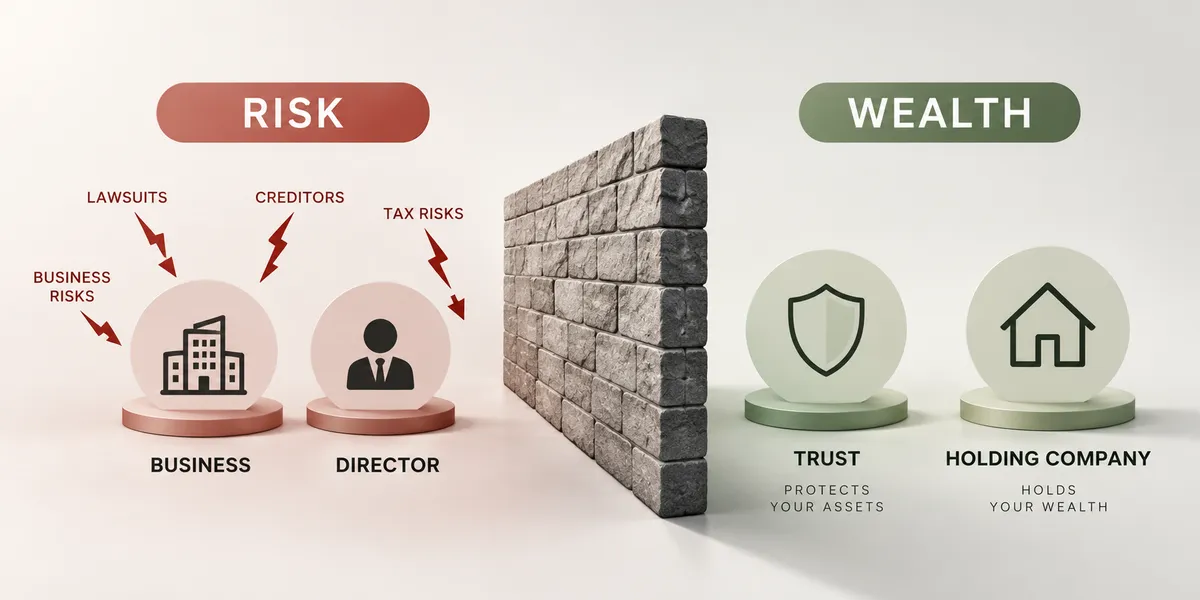
A simple principle sits under most asset protection: the person who takes on risk shouldn't be the person who holds the family's wealth.
For example, if one partner runs a business or works in a high-risk profession, that partner signs the risky contracts and acts as director. The family's assets sit with the lower-risk partner, or in a structure they control. This has to be done carefully and early, because transfers made to avoid a claim can be reversed.
Companies and Trusts
Companies. A company is a separate legal person. Shareholders generally aren't liable for its debts, though directors can carry some risk.
Trusts. In a discretionary trust, no one owns the assets outright. The trustee holds them for the family, and the appointor controls who the trustee is. Using a company as trustee adds an extra firewall between creditors and your assets.
The government has proposed a 30% minimum tax on trusts, due to start on 1 July 2028. It isn't law yet. If it goes ahead, many trusts lose most of the tax benefits they used to have, and paying money out to a company (a "bucket company") can mean paying tax twice: once in the trust and again in the company. That's why we now recommend a holding company owned by a trust, with a company as trustee. Holding Companies
Who Needs Protection?
Business owners: separate your business risk from your personal assets, and protect valuable business assets such as your name and client list.
Investors: tenants and visitors can sue property owners, and insurers sometimes refuse claims.
Employees: you can be personally liable for mistakes, and many employees later start businesses.
Get the Full Brochure
Want the full guide?
The full brochure goes deeper, with more examples and answers to common questions. It's free in our community, along with our free training videos, podcasts and news.
Inside the full brochure:
the principles of asset protection, with worked examples
using companies and trusts step by step, including who should hold each role
asset protection for business owners, investors and employees
answers to the most common questions about insurance, existing structures and timing
Where to Next
Watch the free training: our Free Training Centre has videos on asset protection. Join free to watch. Join Free Community
Read the service page: Asset Protection
Common questions answered: Asset Protection Facts and Myths
Get a customised plan: Standard Consultation
Get it set up: Company and Trust Set Up and Holding Company Set Up
Frequently Asked Questions
I already have a company and trust. Am I protected?
Not necessarily. It depends on who holds each role, what's in each structure, and how the proposed trust changes affect you. If you already have a trust or company, now is the time to have it reviewed, before the changes start.
Can I protect my family home?
There are options, such as a second mortgage strategy, that avoid the stamp duty and tax of transferring it. Second Mortgage Property Protection
When should I set up asset protection?
Before you need it. Once a dispute is on the way, it's usually too late.

Protect what you've built, before you need to
Download the full guide free, or book a call to talk about your own situation.
Know how it works. Keep more of your hard-earned wealth. Leave a legacy.
Education and strategy for Australians who want to protect what they've built. Online, by Zoom.
Email: [email protected]
Free wealth protection training videos.
No credit card. No sales calls.
START HERE
ABOUT
FOLLOW
Important information. Global Wealth Club provides general education and information only. We are not licensed financial advisers, lawyers or accountants, and nothing on this website is financial, legal, tax or accounting advice. Warren has qualifications in law, accounting and financial planning, and we work closely with licensed professionals as the specialists. Our role is to educate you, help you design your overall strategy, and be the bridge to those specialists. Always get advice from a licensed financial adviser, lawyer or accountant about whether a strategy is right for you. We don't sell financial products or take commissions. Read our full Disclaimer.
© 2026 Global Wealth Club. Founded 2019.